
Israel/Northern valleys/rounded sedimentary and volcanic fluvial sands
Israel-Palestinian Authority/Jordan Valley, Israel/Beth She'an Valley, Israel/Jezreel Valley
—
Nahal Harod
Fabric characterized by a calcareous silty matrix, colored dark-brown to opaque under crossed polarized light, and brown under regular polarized light; particles are usually single-spaced and voids are usually 10-20% of slide area with several examples showing laminated voids; the coarse:fine:voids20μm ratio (c:f:v) is 30–50:30–60:15–25. The non-plastic inclusions contain mainly several populations: Limestone fragments, travertine and calcareous concentrations, usually 10–15% of slide area in various sizes, reaching usually 1 mm occasionally larger at up to 3 mm; most are sub-angular to rounded in shape. Some of the particles have the pisolitic appearance (spheroid with a concentrically laminated internal structure) typical of travertine, but most do not. The second component is basalt rock fragments, usually appear quantities of 2–5% of slide area (but in some cases less), and are usually sized up to 0.5–0.6 mm, sub-angular. Other less frequent inclusions are opaque minerals (up to 1% of slide area rounded, up to 0.2 mm), chert (up to 2% of slide area, angular, up to 0.8 mm in size) and quartz (up to 5%, usually angular up to 0.1 mm). Inclusions appearing in small quantities or rarely include chalk, micro-fossils, shell, feldspars, hornblende and olivine (the latter three are mostly basaltic derived). Laminated voids may indicate organic inclusions as straw.


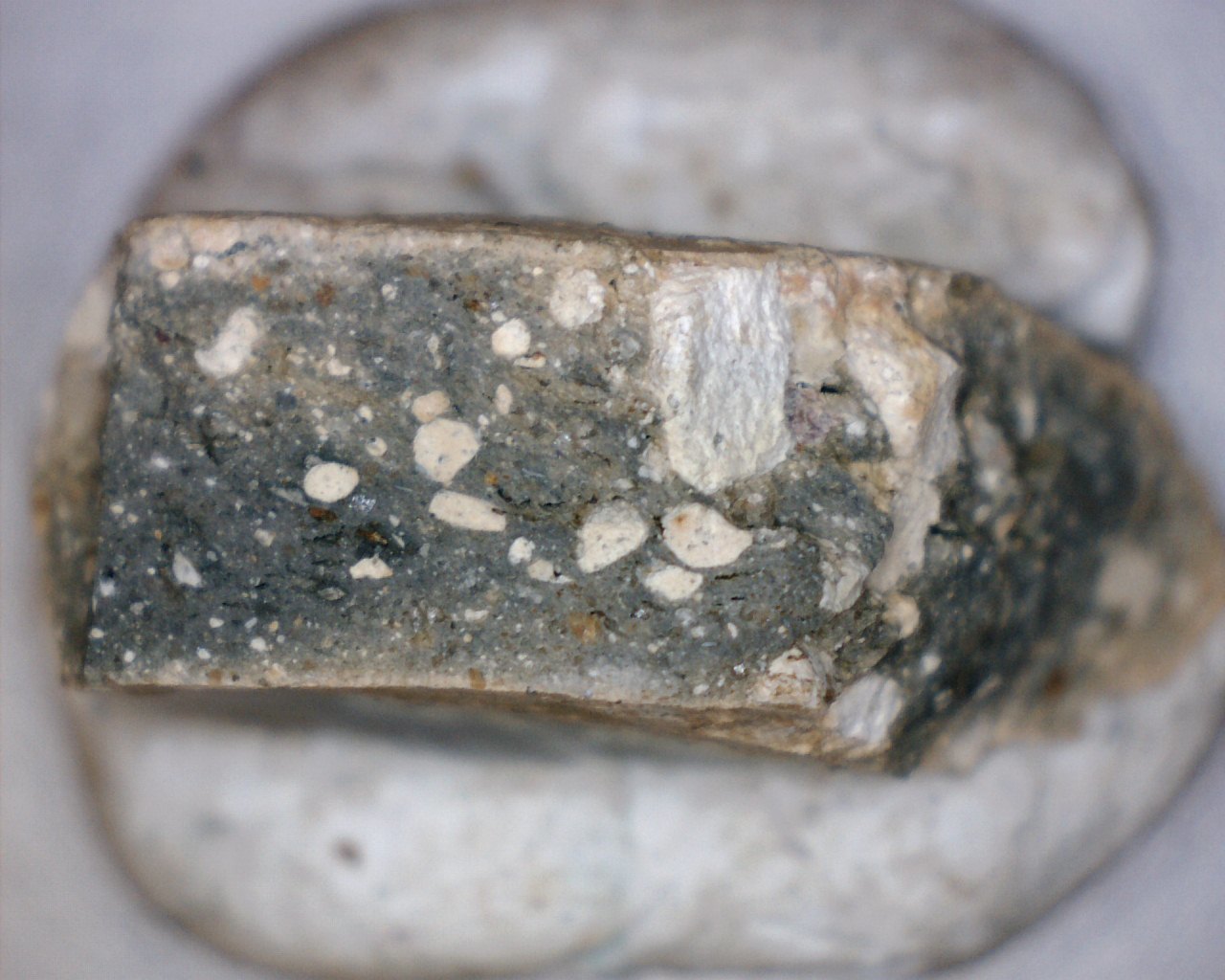
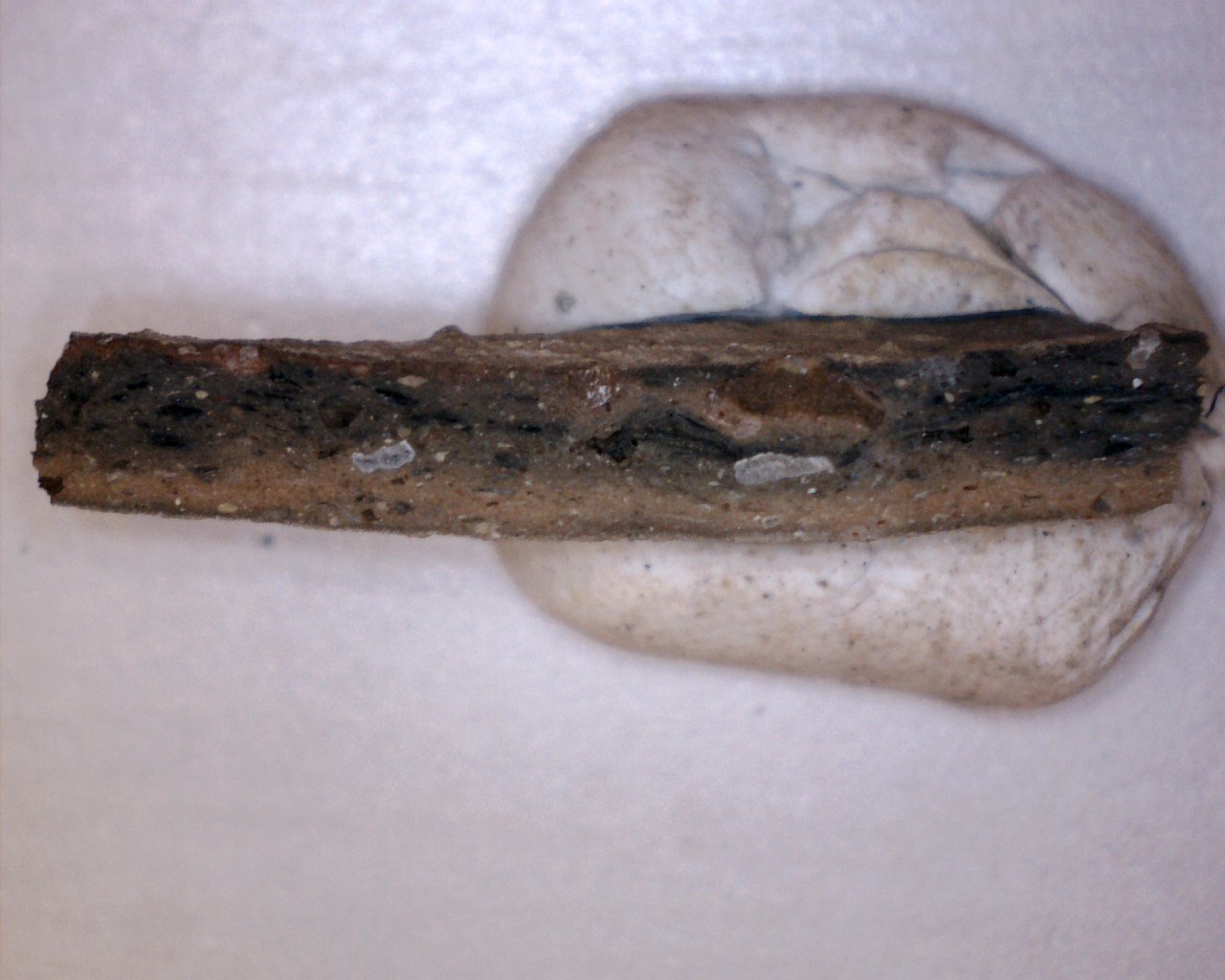

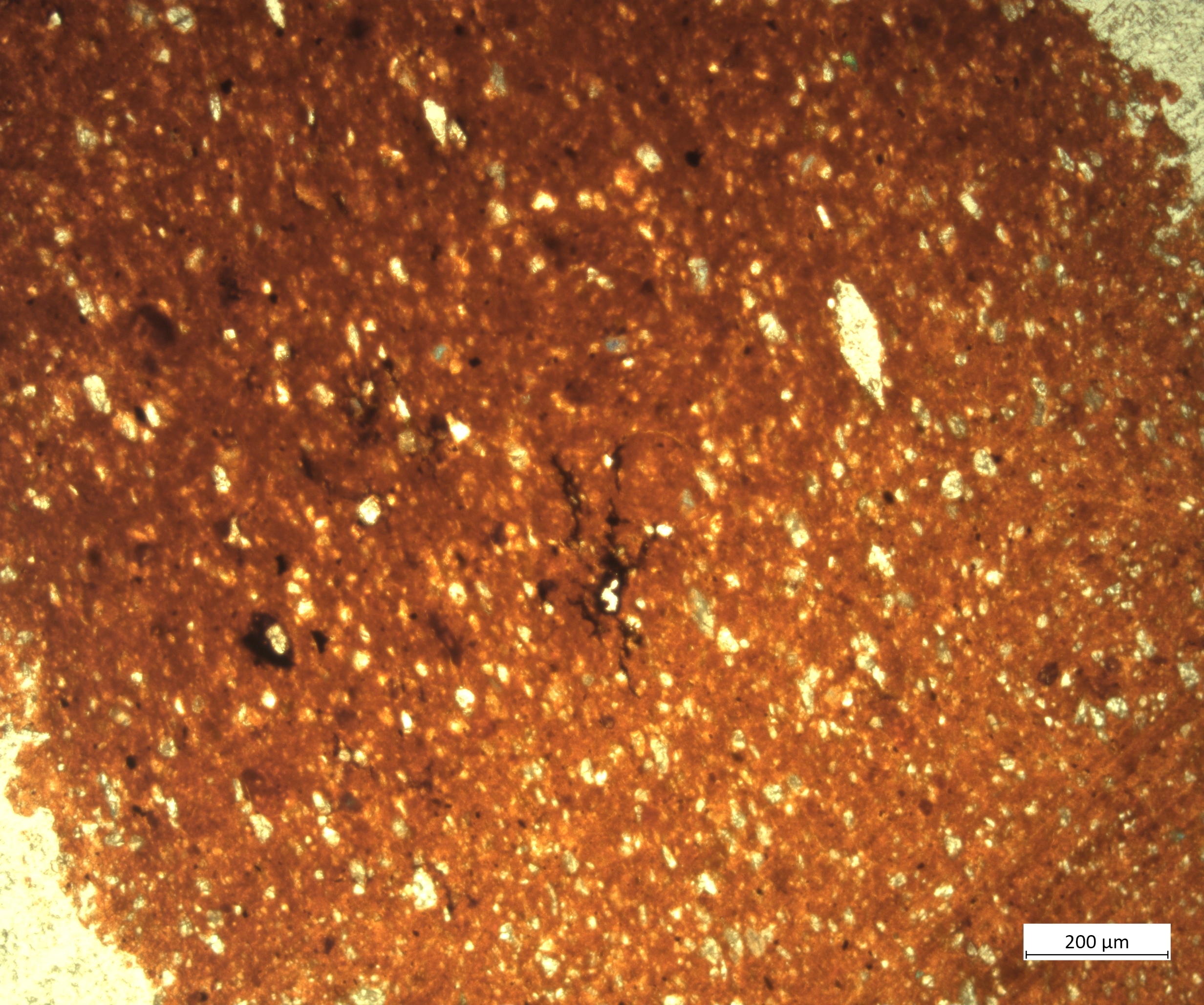
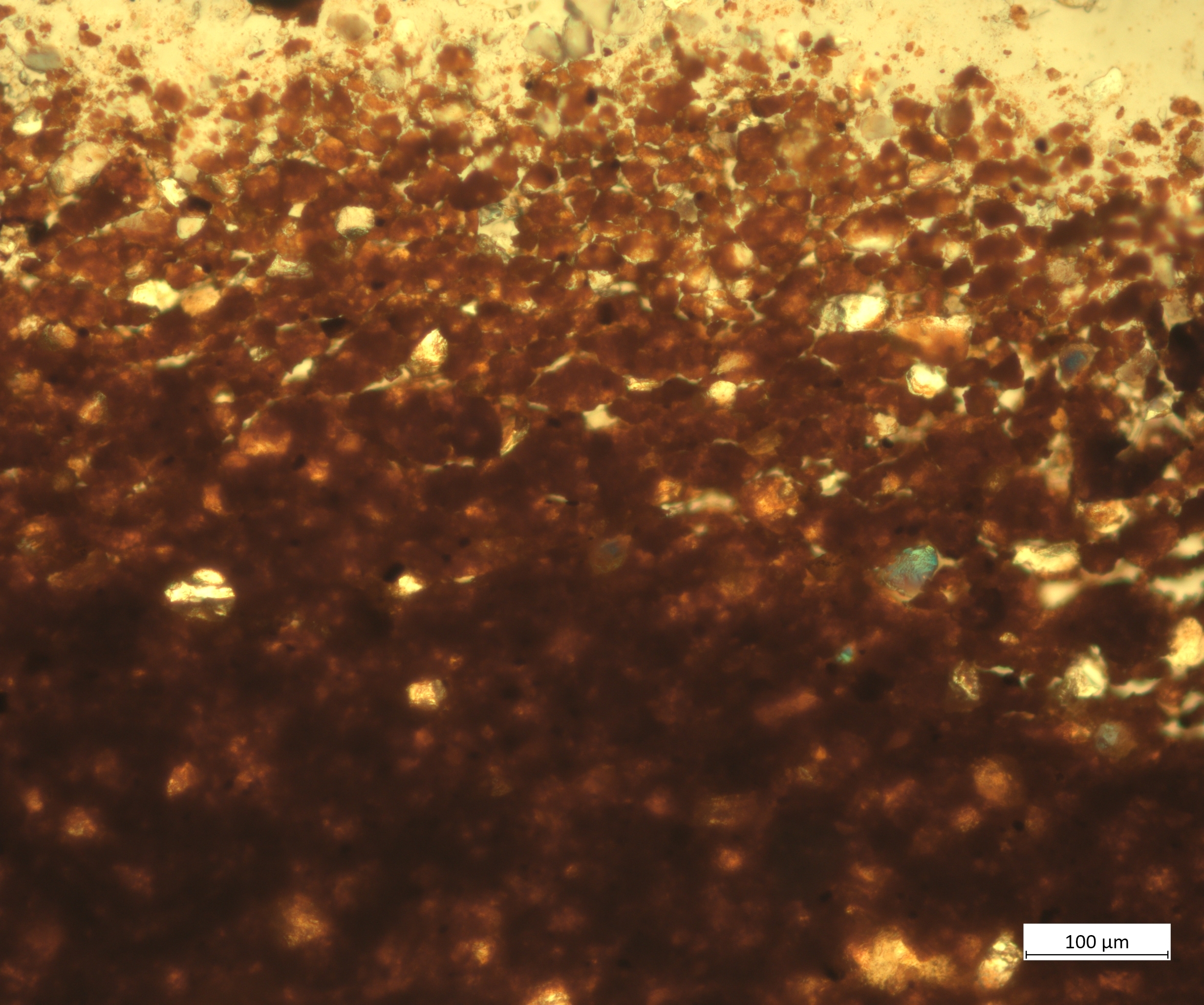
Fabric characterized by a calcareous silty matrix, colored dark-brown to opaque under crossed polarized light, and brown under regular polarized light; particles are usually single-spaced and voids are usually 10-20% of slide area with several examples showing laminated voids; the coarse:fine:voids20μm ratio (c:f:v) is 30–50:30–60:15–25. The non-plastic inclusions contain mainly several populations: Limestone fragments, travertine and calcareous concentrations, usually 10–15% of slide area in various sizes, reaching usually 1 mm occasionally larger at up to 3 mm; most are sub-angular to rounded in shape. Some of the particles have the pisolitic appearance (spheroid with a concentrically laminated internal structure) typical of travertine, but most do not. The second component is basalt rock fragments, usually appear quantities of 2–5% of slide area (but in some cases less), and are usually sized up to 0.5–0.6 mm, sub-angular. Other less frequent inclusions are opaque minerals (up to 1% of slide area rounded, up to 0.2 mm), chert (up to 2% of slide area, angular, up to 0.8 mm in size) and quartz (up to 5%, usually angular up to 0.1 mm). Inclusions appearing in small quantities or rarely include chalk, micro-fossils, shell, feldspars, hornblende and olivine (the latter three are mostly basaltic derived). Laminated voids may indicate organic inclusions as straw.
Beth She'an, Hamadya Farmland (Israel/Beth She'an Valley)
Beth She'an, Scythopolis (Israel/Beth She'an Valley)
Ein Gev (Israel/Jordan Valley north)
Magdala (Israel/Galilee)
Sha'ar Hagolan (Israel/Jordan Valley north)
Tel Dan (Israel/Hula Valley)
Tel Dor (Israel/Carmel coastal plain)
Tel Kabri (Israel/Northern Coastal Plain)
Tel Kinrot, Tell el-‘Oreimeh (Israel/Galilee)
Tel Rehov (Israel/Jordan Valley north)
Tell Megiddo (Israel/Jezreel Valley)
