
Central Anatolian Hellenistic Banded Ware
Turkey/Central
200-50 BCE
Middle Hellenistic, Late Hellenistic/Early Roman I
General Information
Central Anatolian Banded Ware (CABW) is a decorated table ware, made in a fine fabric with a polished surface, with slipped decoration, mainly bands in three colors (red, grey/black and white), which are applied at the exterior or interior of bowls, cups and plates or jugs, jars, kantharoi and amphorae. CABW is located mainly in the central part of Asia Minor, especially in the Halys region (Kızılırmak river). In 1907 Robert Zahn defined a group of painted pottery found in Boğazköy, which shows a high quality in its workmanship, as so-called „Galatian Pottery“. He related this group of pottery to the Celtic Trokmer and with regard to that he wanted to link it to the La Tène Ware of the Danubian region. In 1963 Ferdinand Maier determined for the CABW a proximity to the Iron Age and so-called ‚Late-Phrygian´ Ware as a predecessor for this type of ware. He wanted to locate the pottery exclusively in the Halys region in Central Anatolia – exactly in Boğazköy and in Tavium. Recent research of Mehmet and Nesrin Özsait as well as Levent Zoroğlu shows that the distribution area of this ware is complex and for this reason they proposed a new term of it: "céramique du bassin du Kızılırmak" or " céramique hellenistique polychrome dite de type galate" and “Kızılırmak Basin Ware”. Levent Zoroğlu defined 3 regions of distribution: the Pontic region, somewhere between Amisos and Amaseia, the second in the Halys or Kızılırmak region between Boğazköy and Tavium, and the third region has been located south of the Kızılırmak Basin in Cappadocia.
As CABW occurs together with a special type and fabric of a bowl with inturned rim and Hellenistic mold-made bowls, a date between the 2nd century BCE to the early 1st century BCE can be determined.
There are similarities to the slightly earlier West Anatolian Hellenistic Banded Ware.
Characteristic of the CABW is the decoration, which shows a high quality and consists mainly
of horizontal painted bands in three colors, which can be arranged differently: red, grey/black and white.
The clay of the CABW is fine, hard fired and its color varies from light red to dark buff (5
YR 6/6- 7/6) with few mica and sand particles. The surface was polished in order to achieve a smooth shine. The form repertoire of the CABW ranges from bowls, cups, plates, jugs like lagynos, oinochoe, amphorae, kraters, small jars and rhyta.
The most common type is the carinated bowl. Their diameter varies from 0,20 m to 0,35 m. The decoration is limited to the shoulder of the carinated part of the body and on the interior of the bowl. Two more popular types are the bowl with out-turned rim, decorated on the interior of the vessel and the bowl with in-turned rim and conical body with ring foot, decorated with simple bands on the rim and concentric circles on the interior. Cups are the second group of open vessels, which were popular for the CABW. The hemispherical cup and the cup with flat base are decorated with concentric bands on both sides. Plates show different rim types like overhanging, flat or convex and are decorated with bands and geometrical or floral motives on the rim and interior.
The most striking feature of the CABW is the white, black to grey and brown to reddish painting, while the white painting could also be applied on the rim and the interior serving as a kind of undercoating for the polychrome painting. The main motives are bands and lines, but also geometric and floral motives like crosses, chevrons, triangles, dot friezes, dot rosetttes, palmettes, ivy, ivy garlands, olive garlands, leaves with a central bud and birds.
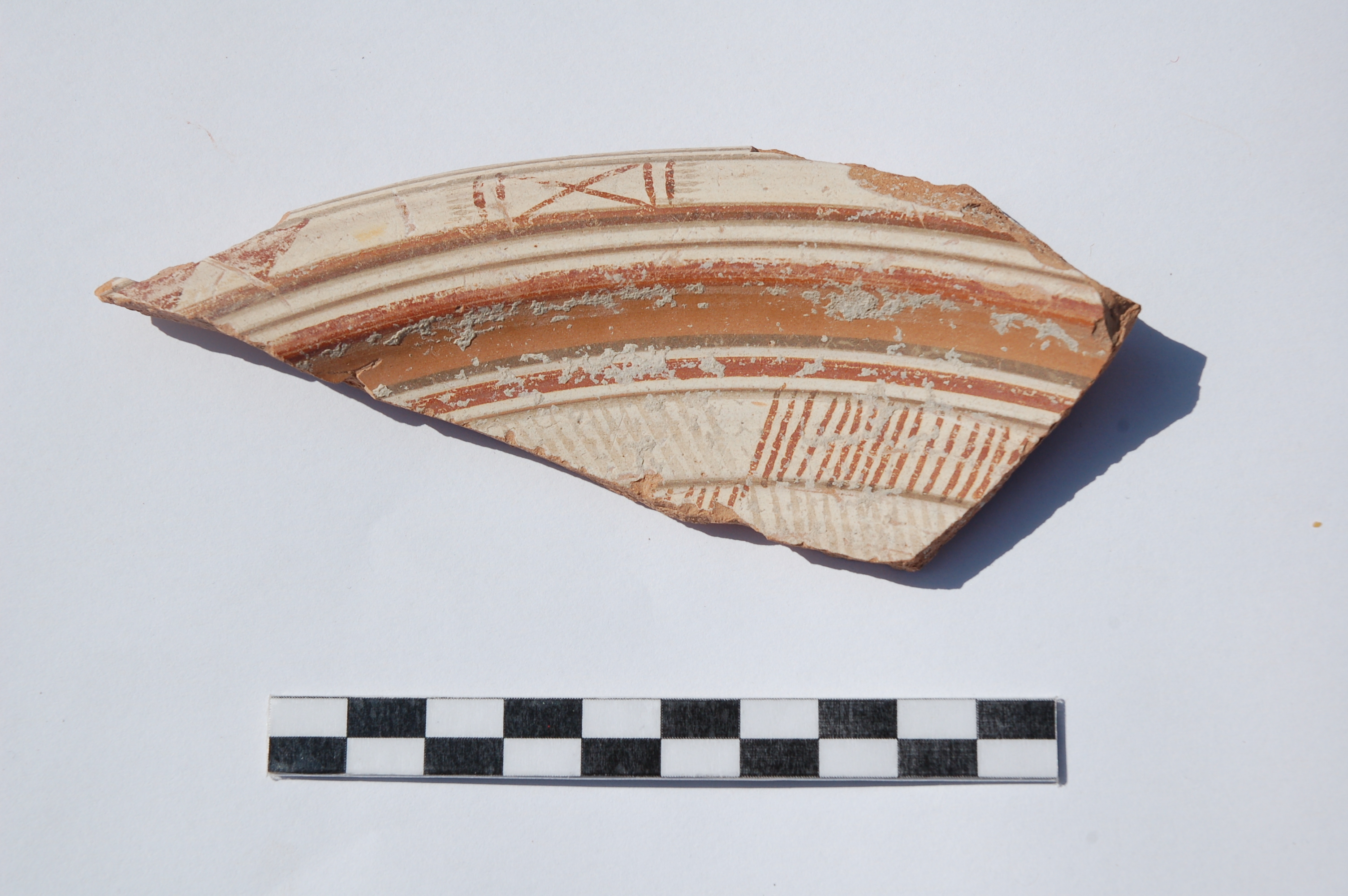
Galatian
Ware (galatische Ware), ‘Kızılırmak Basin Ware’, ‘céramique du bassin du
Kızılırmak’ or ‘ céramique hellenistique polychrome dite de type galate’
Tavium (Turkey/Central)


