
Pergamene Sigillata/Eastern Sigillata C (ESC)
Turkey/Aegean/Mysia
Early 1st century BCE to 2nd/3rd century CE
Late Hellenistic/Early Roman I, Early Roman II

A group of Pergamene sigillata vessels from Sardis (photo by Hannah Hoffman and Caroline Everts)
General Information
Due to the existence of potters’ workshops it is known that red-slipped pottery of late Hellenistic and Roman date was produced in Pergamon. This type of pottery has been labelled differently in recent decades as a result of different characterizations.
Similar vessels had been produced in Pitane, a site not far from Pergamon on the coastline of western Asia Minor. Macroscopic observation cannot distinguish between the Pergamenian and Pitane production either by fabric and surface treatment or by form and decoration, and as the repertoire of the Pitane production is not well known, K. Kenyon’s term Eastern Sigillata C is the best solution to describe this ware in general. The specification of Pergamenian Sigillata/Eastern Sigillata C made in Pergamon or Pitane Sigillata/Eastern Sigillata C made in Pitane can be only given when chemical analyses are executed.
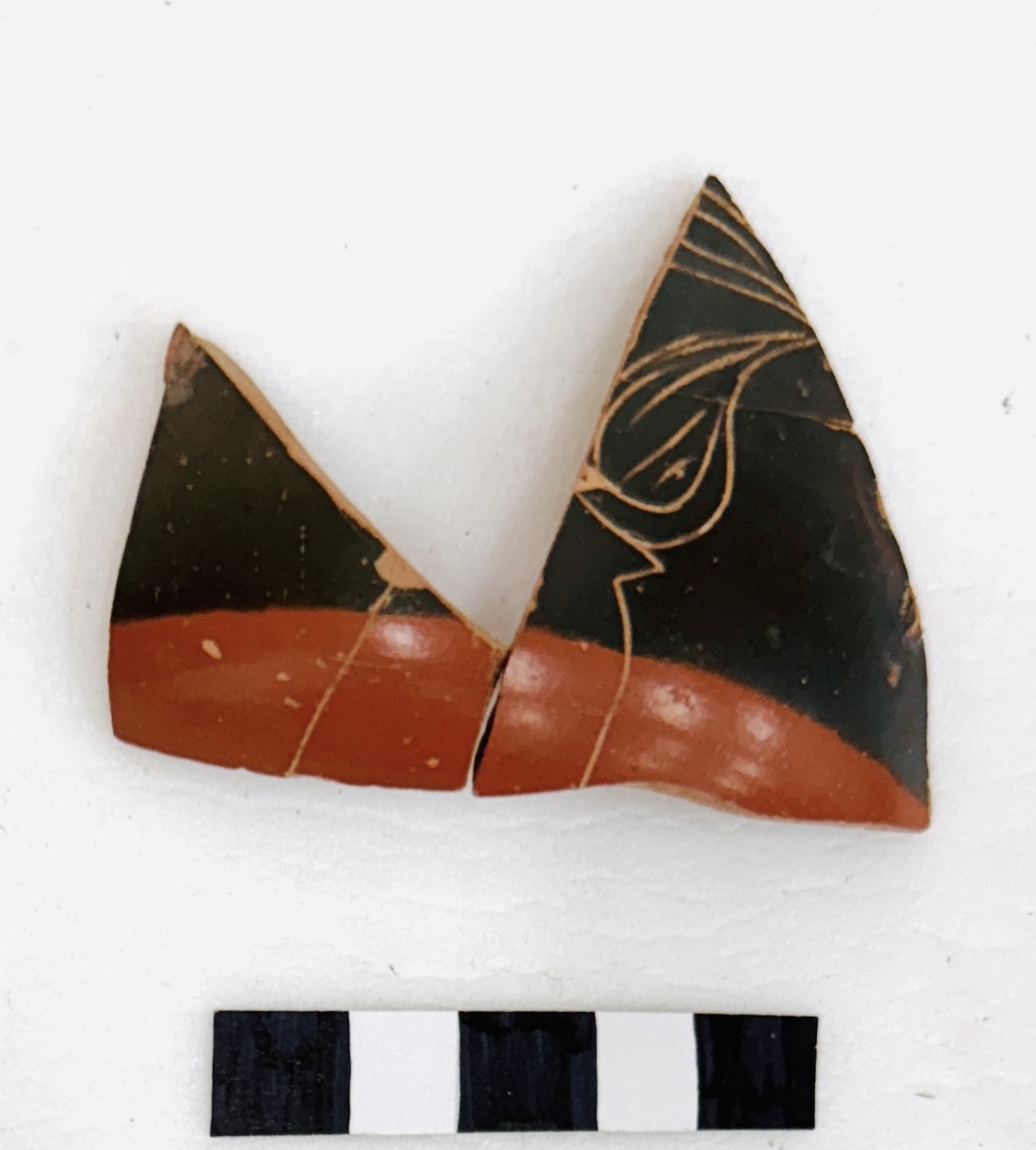
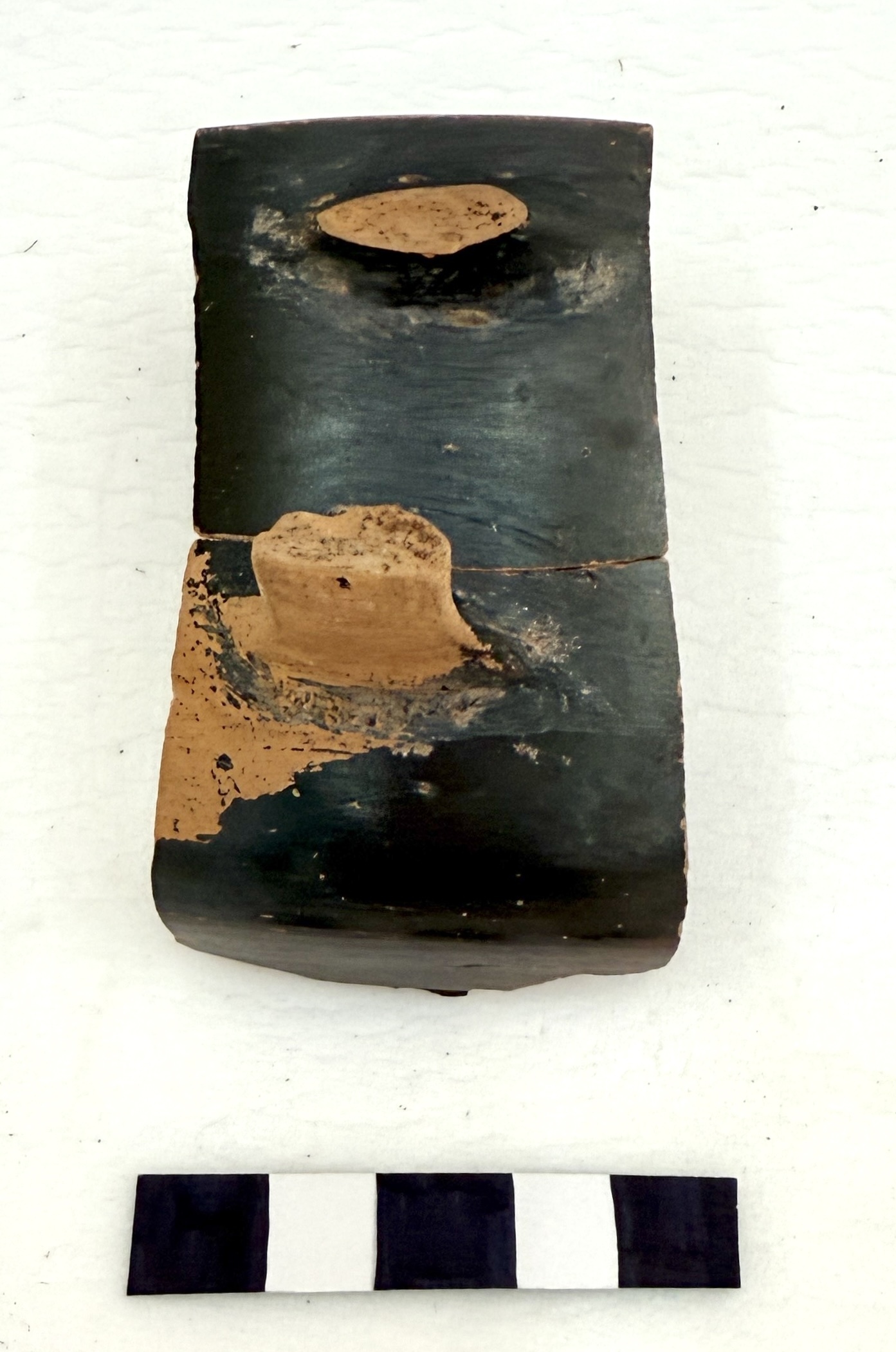
The latest definition of Eastern Sigillata C is technically based in order to get a more general and objective description of the group: Most of the interior and/or the exterior of the vessel – depending on whether it is an open or closed vessel – has to be covered by a dense, red and slightly shining slip. The colour red ranges from orange to orange red, brownish red and reddish brown. The intensity of the slip’s shine can vary. In case part of the surface displays another colour – in the Pergamenian production the second colour is black or brownish black – this has to be clearly separated and of homogenous kind. This phenomenon of a bi-coloured surface was used decorative element.
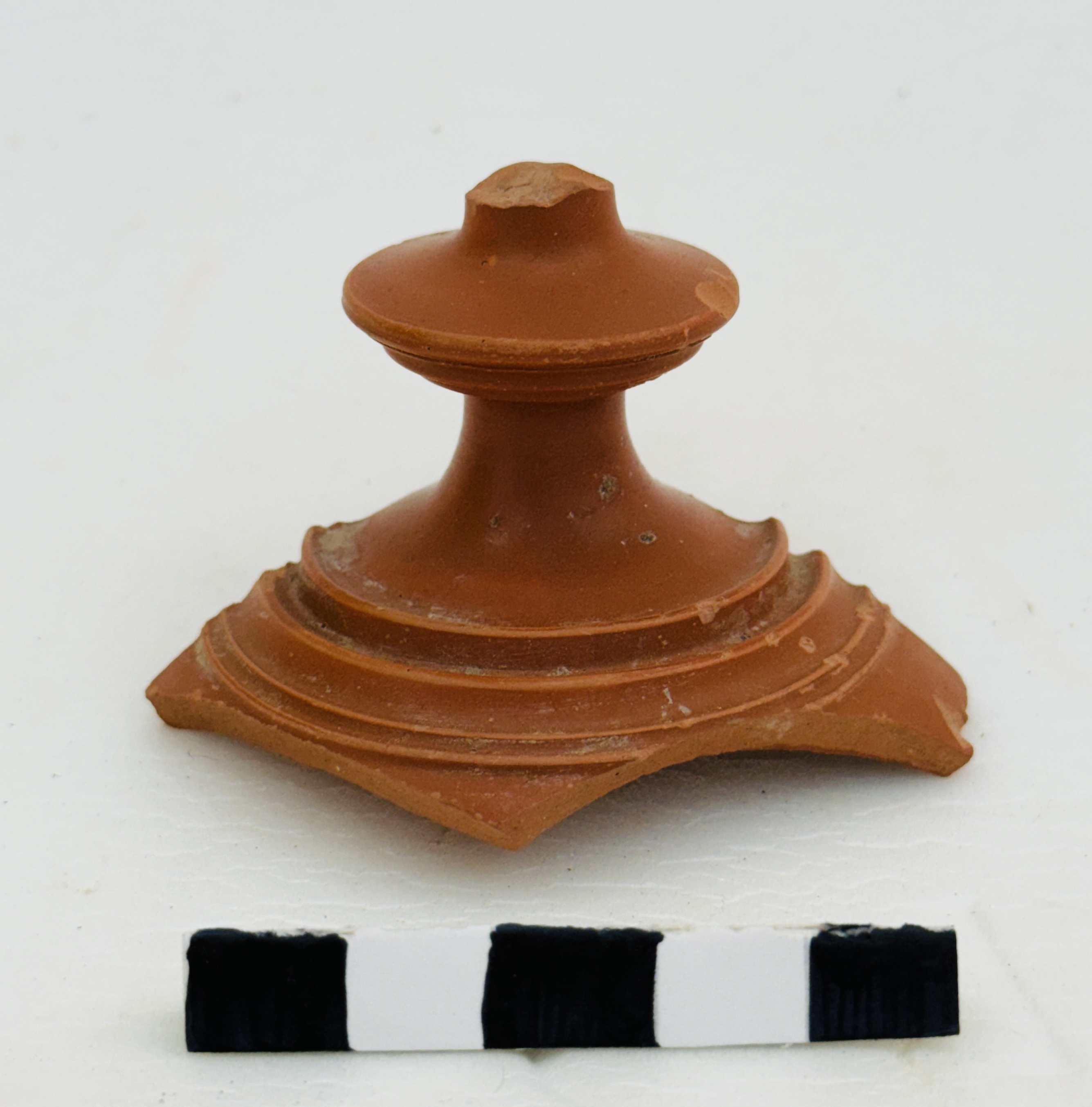
The vessels of Eastern Sigillata C made in Pergamon comprise open and closed forms, although open forms are in the majority. Different kinds of dishes, plates and bowls as well as skyphoi, beaker, goblets and chalices comprise the repertoire together with small jugs and pyxids. Some of the forms are developments of Hellenistic forerunners, while others were influenced by Italian models or are local inventions.
Only a few types were decorated. Extant examples include incised and painted motifs in West Slope style, mold-made relief vessels, applied decorative elements and a sandy coat. A small number of open vessels such as skyphoi and krater have been decorated with incised and painted motifs. These include incised horizontal lines surrounding a painted line of white dots bordering an incised motif, for example a wavy line, ivy garlands or figures such as griffins (Meyer-Schlichtmann 1988, 190). This decoration was a continuation of the Hellenistic West Slope Style and common until the early 1st century CE.
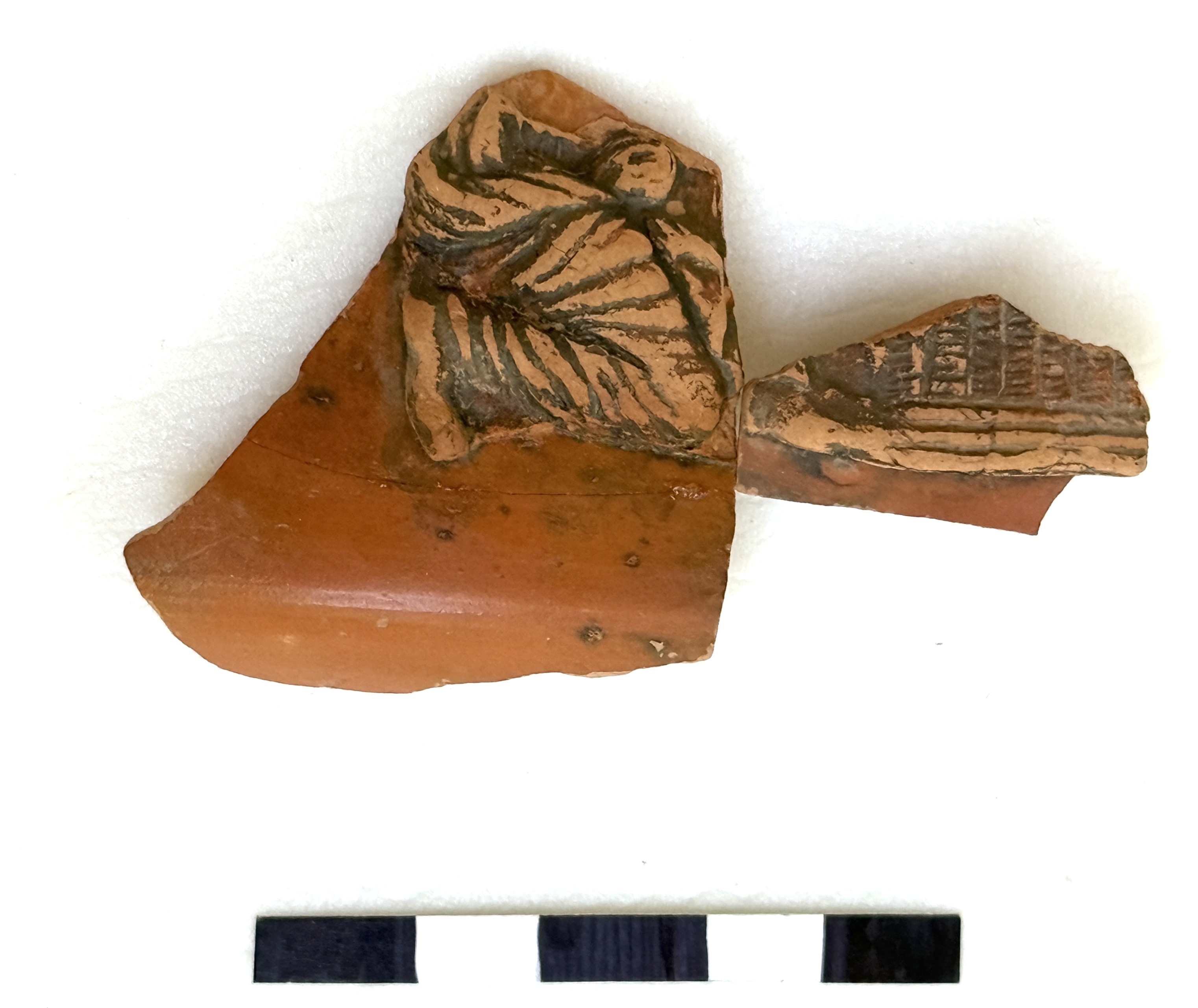
Applied elements can be found on Pergamenian Sigillata (so-called Applikenware). Different ornamental and figural motifs can be distinguished such as ivy bunches, garlands with erots, mythical figures and symplegmata on the exterior body walls or portraits and heads in the centre of open vessels (Hübner 1993). Pergamon was one of the primary production centres of so called Appliqué Ware, which can be placed between the 2nd century BCE and the 1st century CE. Another kind of decoration represents relief vessels made in Formschüsseln (Meyer-Schlichtmann 1998, 191). This was mainly used on vessels such as krater-like goblets. Typical motifs are egg and dart as transition zone towards the rim, and garlands and arcades with inserted motifs such as ivy leaves or rosettes for the body zone. This decoration was most likely an adoption of Western Sigillata ideas and can be observed only during the late 1st century BCE and the early 1st century CE. While the first two decoration types can be found even on non-Sigillata (that means on vessels with a brown or black slip), the latter was restricted to red-slipped Sigillata. Extant in smaller numbers are vessels covered with sand on the exterior. Found only on cup-like vessels, sand-covered exteriors were not limited to red-slipped, but also to black- and brown-slipped pottery. The exterior surface displays a coat of sand on top of the slip from the foot up to 1-2 cm below the rim. This decoration is again an adoption of Western Sigillata ideas occurring between the late 1st century BCE and the mid-1st century CE.
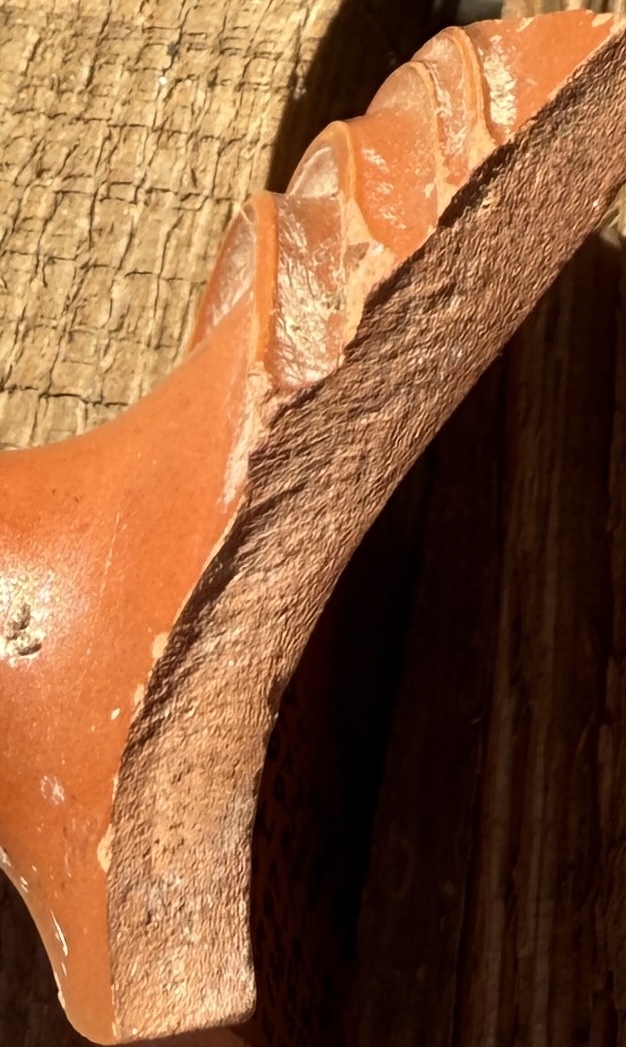
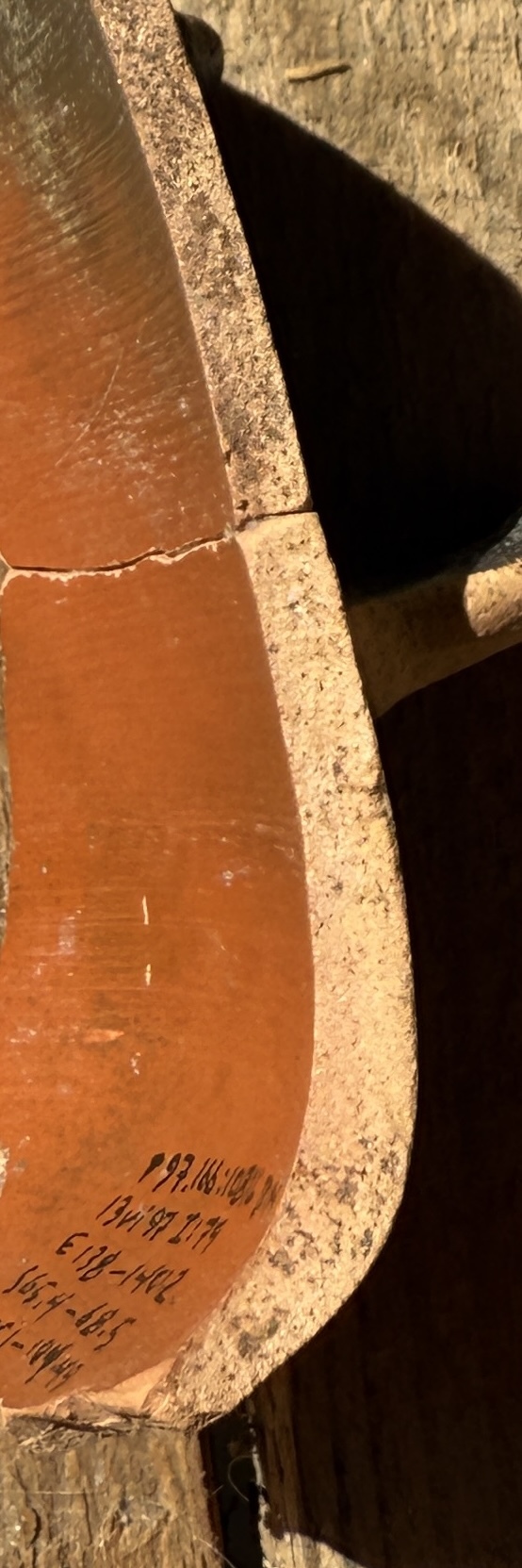
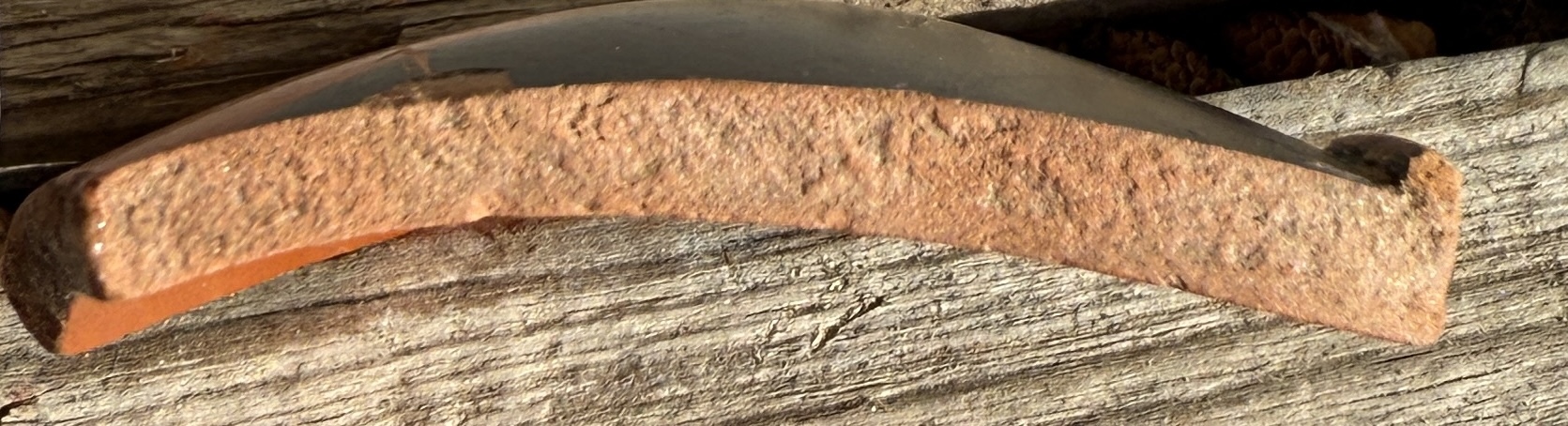
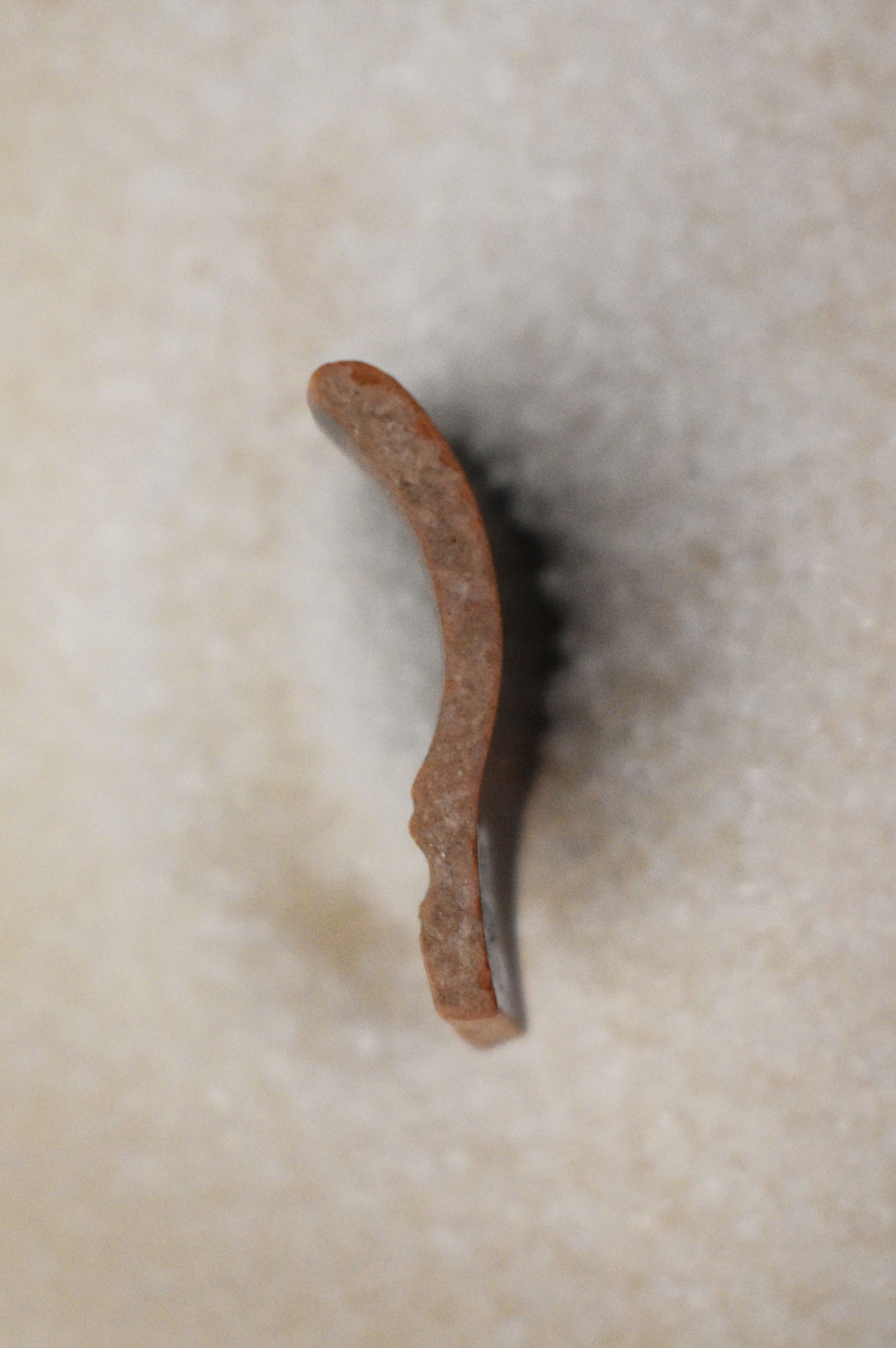
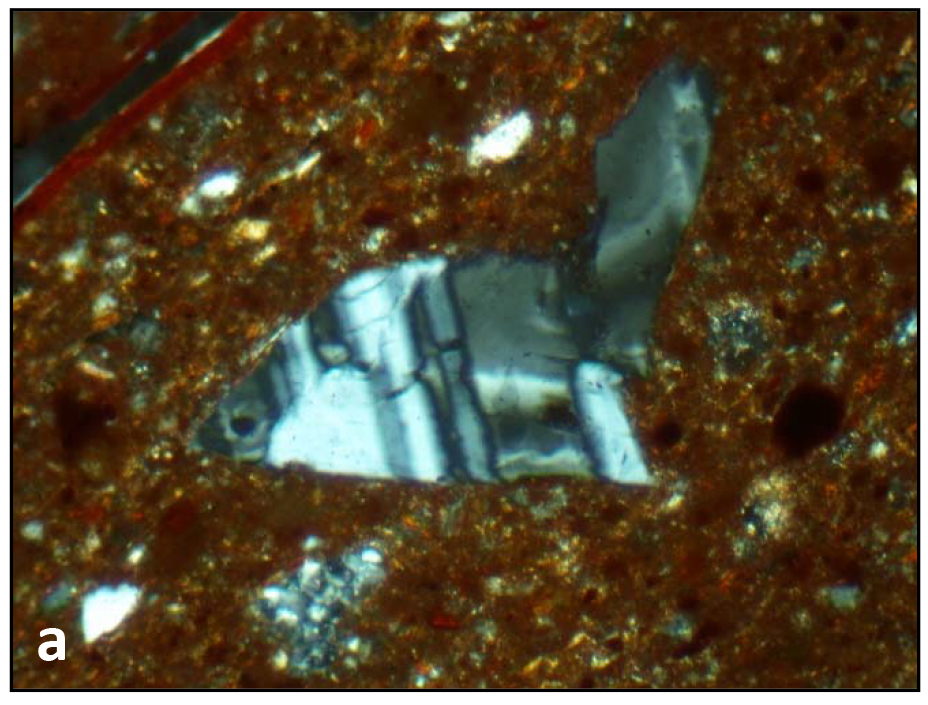
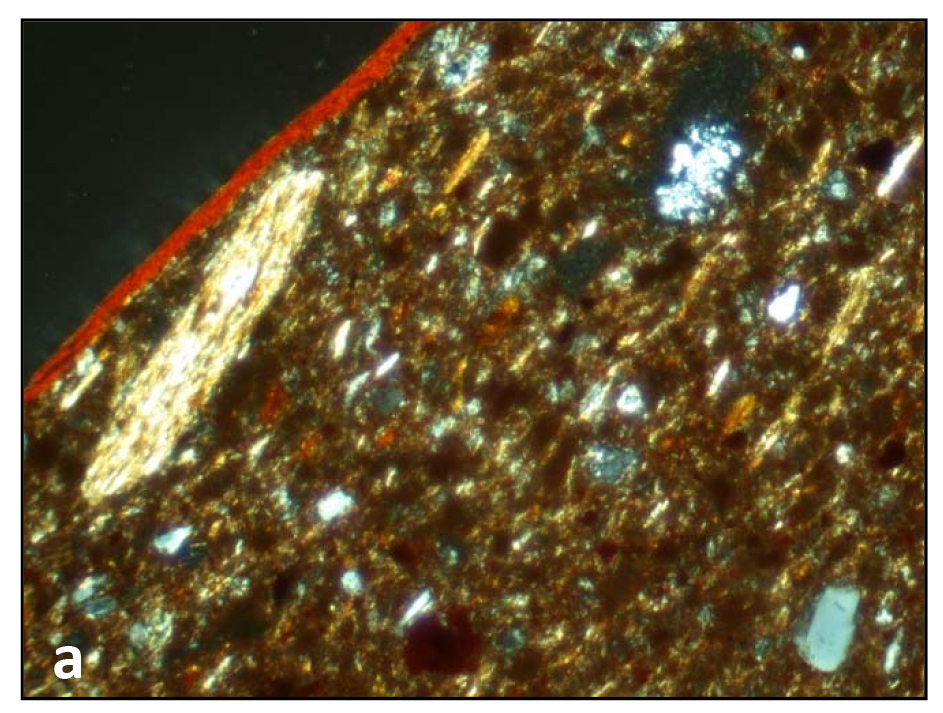
Pergamene Sigillata/ESC is of fine clay texture with a few fine micaceous inclusions and a few fine matt white-coloured inclusions, often identified as lime particles, and sometimes a minor number of small dark inclusions. The colour of the clay can be described as orangish to orangish red to reddish brown (2.5 YR 6/6, 2.5 YR 6/8 etc.). The firing was well done as the vessel’s corpus is hard (not to be scratched by finger nails). The breakage areas are hard and irregularly slivered.
The slip is mostly dense and displays a medium intensity of shine, which can vary. The scope of the red colour ranges in Pergamon between orange, orangish red and brownish red to reddish brown (2.5 YR 5/6, 2.5 YR 5/8, 5 YR 6/6, 10 R 5/8). Most of the vessels were slipped completely and regularly, although sometimes the area underneath the feet was not covered. Some pieces have been put on their bases after the dipping and therefore slip drips are visible on the exterior.
Asia Minor Sigillata group B (Zahn 1904, 40-47): R. Zahn stated in 1904 that his Asia Minor Sigillata group B was produced in Pergamon (Zahn 1904, 40-47). The clay body was described as non-micaceous buff clay covered by a red and glossy slip. The vessels comprised Arretina forms and forms influenced by the local Hellenistic production, with production beginning in the 2nd century BCE. However, due to the description of the fabric, this was probably not Sigillata produced in Pergamon.
Knipowitsch group C ((Knipowitsch 1929, 21-29): T. Knipowitsch classified the Pergamenian Sigillata as her group C (Knipowitsch 1929, 21-29) with brownish red-slipped vessels of Augustan date produced in Pergamon and Pitane. In her group the slip was of lesser quality than the Arretina one. This group was not equated with Zahn’s Asia Minor Sigillata group B because of differences in shape and fabric.
Pergamene Ware (Waagé 1948, 18-28, 32-38): F. O. Waagé used the term Pergamene Ware to describe vessels with a red slip (Waagé 1948, 18-28. 32-38). He divided the ware into Hellenistic Pergamene Ware and early Roman Pergamene Ware to distinguish the diverse sets of forms.
Eastern Sigillata C (Kenyon 1957, 281-288): This term was introduced by K. Kenyon in 1957 (Kenyon 1957, 281-288). She used it for the type of pottery found in Pitane (based on the publication of Loeschke 1912, 344-407), but stated that there might have been other production places, but without mentioning Pergamon. Eastern Sigillata C came to be one of the most frequently used terms for this ware type, although sometimes with a slightly differing characterization of style or production place. For example, P. Hellström used Eastern Sigillata C for the Sigillata production of Pitane and Pergamon (Hellström 1965, 29-30).
Lokal-pergamenische Ware (Schäfer 1962, 777-802): J. Schäfer classified the Sigillata of Pergamon with a new name to emphasize its local production (Schäfer 1962, 777-802). He described vessel’s slip as orangish red to reddish brown, more or less shiny and often irregular. The vessel forms are more numerous as he included Hellenistic forms with a kind of pre-red slip. Therefore, chronologically the Lokal-pergamenische Ware ranges from the 2nd century BCE to the 1st century CE.
Echt-pergamenische Ware (Ziegenaus – de Luca 168, 155): G. de Luca used this name for vessels with red slip definitely manufactured in Pergamon (Ziegenaus – de Luca 168, 155). The ceramic she included in this group can be dated between the late 1st century BCE and the late 1st century CE, so several Hellenistic forms are not extant, and the repertoire is mostly influenced by Italian models.
Pergamenische Sigillata (Meyer-Schlichtmann 1988): C. Meyer-Schlichtmann introduced a new term which is now – aside Eastern Sigillata C – common (Meyer-Schlichtmann 1988). As his classification was meant to be a kind of continuation of Kenyon’s system, Pergamenische Sigillata should have been used on an equal level to the other Eastern Sigillata groups, but with the distinct knowledge of the production place. So he consciously separated the Pergamenian and Pitane production. The slip colour of Meyer-Schlichtmann’s Pergamenische Sigillata had a wider variety than previously; he incorporated black, brown, reddish brown and red as well as bi-coloured vessels. For the first time the red colour was not the dominant or sole characteristic of this ware type. For him Pergamenische Sigillata started in the second half of the 2nd century BCE and was in the mid-2nd century CE removed by the late Roman Rotfirniskeramik. Hence, apart from Italian-influenced vessels typical Hellenistic forms and local inventions are now labelled as Sigillata.
Red-gloss wares of the Pergamon region (Hayes 2008, 49-52): This term was used by J. W. Hayes to again describe vessels with a red slip (Hayes 2008, 49-52). He distinguished two groups. The first group was produced in Pergamon and Pitane in the 1st centuries BCE/CE, the second one only in Pitane commencing in the late 1st century CE and lasting until the second half of the 3rd century CE. The first group includes forms of Hellenistic origin as well as the Pergamenian inventions, while the second group displays forms known as the early Late Roman C ware.
Notion (Turkey/Aegean)
Pergamon (Turkey/Aegean)
Pitane, Çandarlı (Turkey/Aegean)
Sardis (Turkey/Aegean)
