
Syrian Brittle Ware of the Roman-Byzantine period
Syria/Orontes Valley, Syria/Homs Desert, Syria/Al-Jazira, Turkey/Central Euphrates
1st-7th c. CE
Roman, Byzantine
General Information
Brittle Ware is a general name for hard, thin-walled cooking vessels characteristic of sites in Syria and along the Middle Euphrates from the early Roman through the Byzantine period. Brittle ware vessels were made from terra rosa and alluvial clays, which fired to a dark red or black color. Vessels were made on a fast wheel, with thin, corrugated walls and burnished surfaces. Three main shapes were produced: a deep cooking pot with a narrow mouth, a wide-bodied casserole, and a jug, probably used for heating water. Large scale manufacture of these utilitarian shapes occurred at several locales in northwestern Syria and seem then to have been distributed further inland (Vokaer 2010a, 2010b, 2011, 2013, 2014). Petrographic analyses have distinguished different fabric groups (Brittle Ware groups 1, 3, 4, and 6, in Vokaer's terminology; Vokaer 2013) which seem to correspond also with minor typological distinctions between shapes. As the general forms are the same across these various fabric groups, and as the fabric distinctions are not easily identified by eye, it seems more useful at this time to consider Brittle Ware vessels part of a widespread, long-lived ware family which encompassed a numer of discrete productions.
In the Roman period, Brittle Ware can be divided in 3 main fabrics, corresponding to 3 workshops (Group 1, 3 and 4) (see petrography). Group 1: the fabric is characterised by iron-rich clay with abundant sand, firing red (Munsell 2.5 YR 5/6 to 4/6), red-brown (Munsell 2.5 YR 4/4 to 4/6 or 4/2) or grey-black (Munsell 2.5 YN 3). The porosity is high and elongated in shape. The main inclusions are clear quartz of two size ranges. Group 3: the fabric is characterised by relatively iron-rich clay, red to brown or grey-black in colour (Munsell 2.5 YR 5/6 or 2.5 YN3). The matrix contains various minerals appearing as multi-coloured sand (quartz, micas, chert, calcium carbonates, feldspaths etc). Group 4: this fabric is similar to Group 1. It is characterised by iron-rich clay with abundant sand, firing red (Munsell 2.5 YR 5/6 to 4/6), red-brown (Munsell 2.5 YR 4/4 to 4/6 or 4/2) or grey-black (2.5 YN 3). The porosity is high and elongated in shape. The main inclusions are clear quartz (two size ranges) and chert fragments. Microscopically, the main difference with group 1 is the abundance of chert. They appear grey, red or whitish under the binocular microscopic. Group 6: the fabric is characterised by iron-rich clay, generally red or red-brown (Munsell 2.5 YR 5/6). The porosity is lower than in groups 1 and 4. Inclusions are also smaller in size and mainly consist of angular quartz and iron-rich black nodules, sometimes visible on the surface.


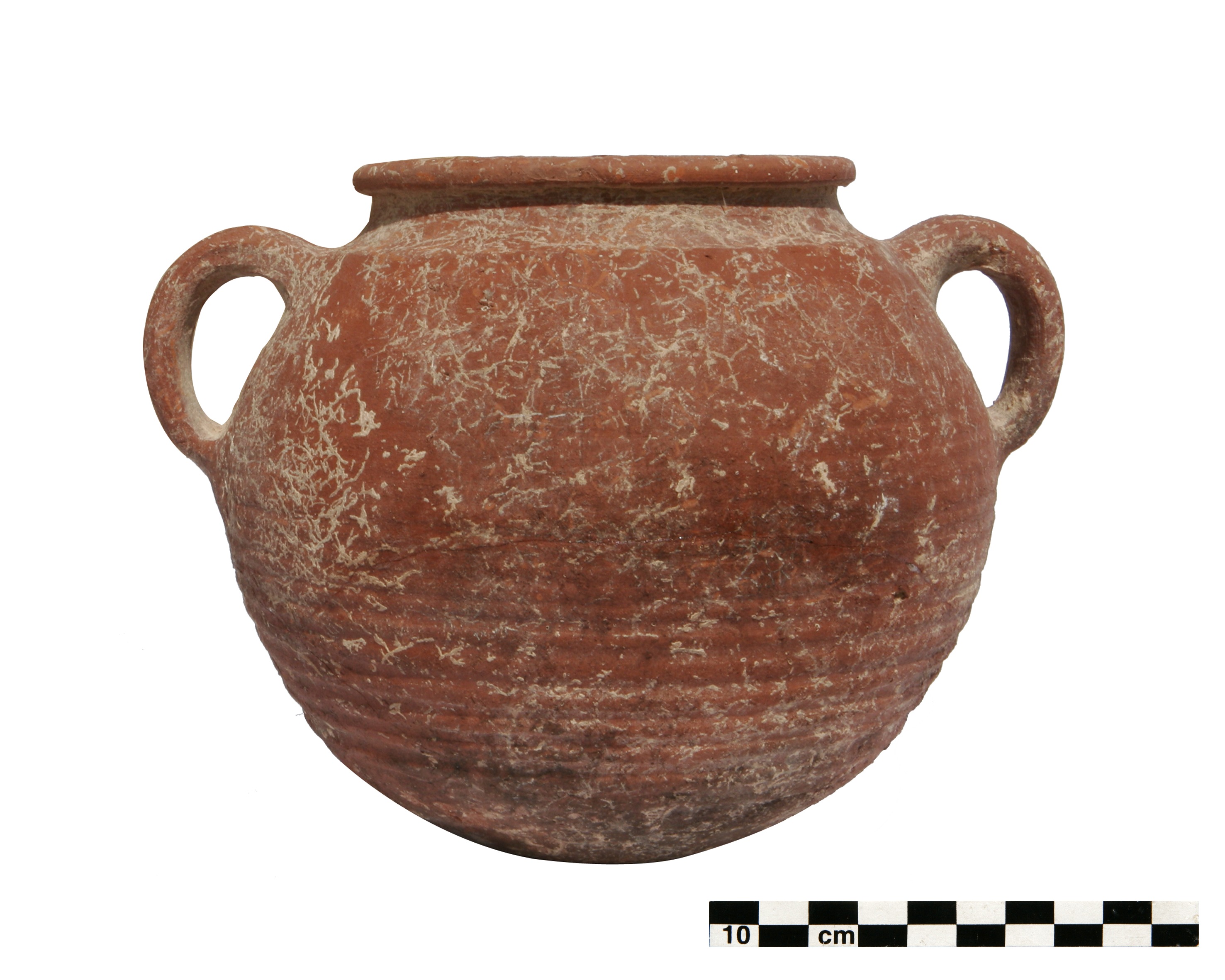


Abila (Jordan/Northern Highlands)
Aleppo (Syria/Homs Desert)
Apamea (Syria/Orontes Valley)
Dibsi Faraj (Syria/Homs Desert)
Dura-Europos, Salhiye (Syria/Euphrates River valley)
Antioch/Antakya (Turkey/Eastern Mediterranean)
