
Jerash Pale Ware (Subware/Variant: Transitional Cream/Pale Ware)
Jordan/Central Highlands
Late 8th to 9th century CE
Early Islamic - Umayyad/Abbasid
General Information
Jerash Pale Ware represents a distinct common and utilitarian pottery production characteristic of the late Umayyad to early Abbasid transition in North-Central Jordan. First systematically isolated in domestic stratified sequences by the Late Antique Jerash Project (LAJP), it is strongly attested in post-AD 749 earthquake occupational and destruction horizons (notably within sealed deposits in LAJP Trench 1 and Trench 6).
Stylistically and functionally, Jerash Pale Ware represents the local Gerasene response to the broader regional phenomenon of the Islamic Cream Ware family (ICW A / Buff Ware https://www.levantineceramics.org/wares/1136-early-islamic-cream-wares-jordan-palestine). While sharing general morphological types and utilitarian functions with ICW A plain and coarse wares, it differs in paste texture and surface treatment.
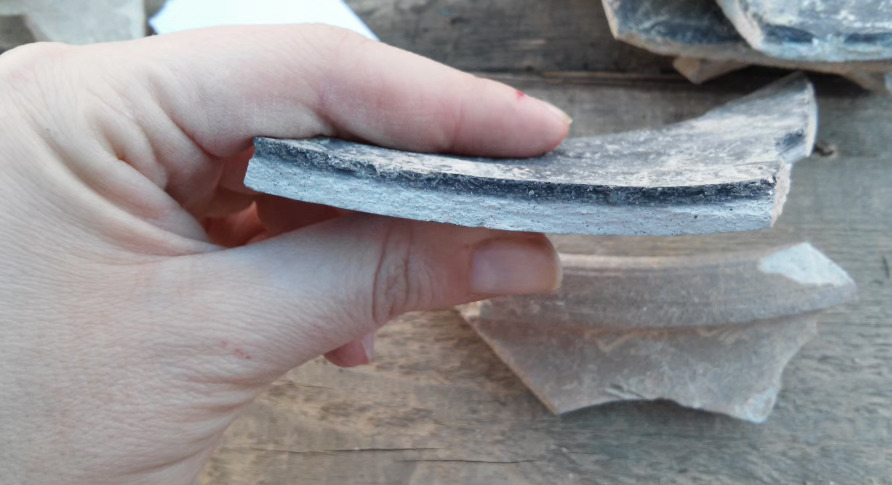
Production & Petrography Note: Pending dedicated archaeometric and petrographic testing, the local Gerasene manufacture is currently presumed on macroscopic grounds. The high frequency of severe firing anomalies (bad firing)—such as reduced pale grey cores/surfaces, flaky suface, and faded painted motifs, strongly suggests local workshop manufacture or the systematic utilization of second-choice local vessels within the city.
Manufacture: Wheel-made.
Visual Fabric & Firing Characteristics (Hand-Lens Examination):Munsell: 7.5 YR 7/3–7/4; 10YR 8/4.
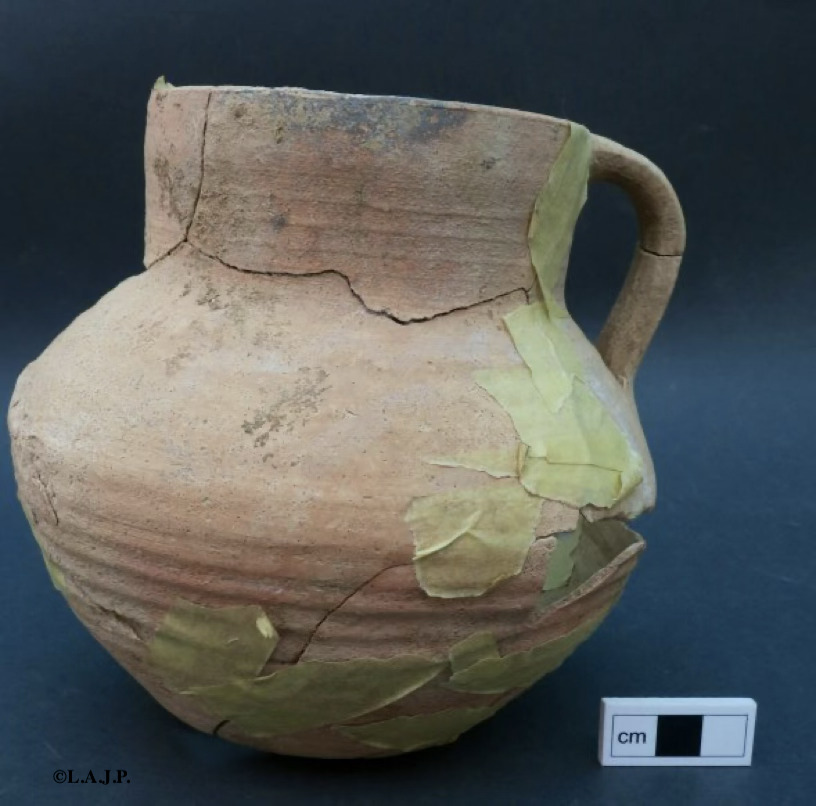
Ranges from light buff to pinkish tones, with frequent variations in a single vessel due to uneven firing. Reduction-fired specimens exhibit pale grey or two-tone light grey and black sections.
Physical Aspects: The fabric is less compact and more friable than traditional Gerasene Red-Orange Ware (Jerash Red Orange Ware), often presenting a soft or flaky surface texture.
Inclusions: frequent tiny-to-medium white lime/calcite inclusions (visible both in break and on the surface), scattered mineral grits, and characteristic voids/vacuoles.
Vessel Repertoire: Jugs & Juglets: Bi-handled jugs featuring a carinated lower body, inner omphalos base, cylindrical neck, and rounded rim (evolving from Byzantine/Umayyad Gerasene bi-handled prototypes). Single-handled jugs with flared body, cylindrical neck, rounded rim, and pronounced wheel-ridging.
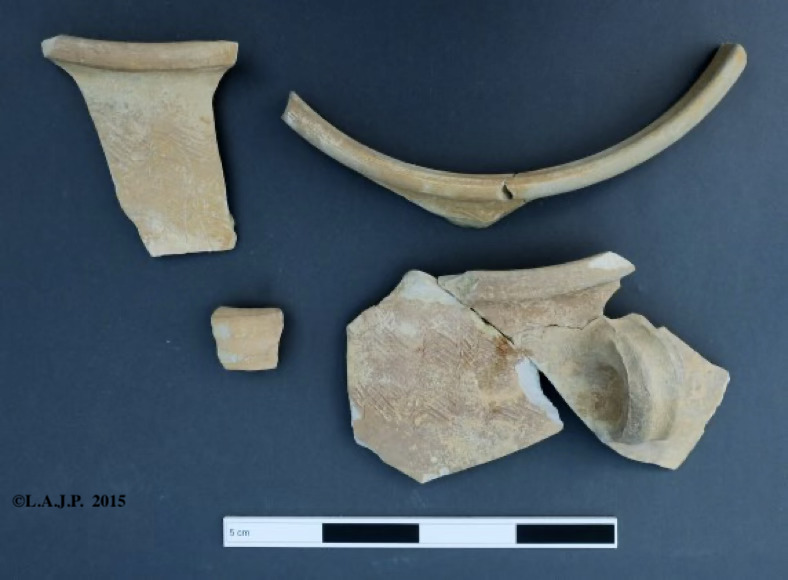
Storage Jars: Globular-bodied jars with omphalos bases and specialized rims, including double rims with pre-firing perforations/holes on the shoulder and incised zig-zag lines. Open Shapes: Carinated bowls with vertical ear-shaped handles decorated with incised wavy lines, and shallow dishes with ring bases.
Amphorae: Transport/storage vessels matching the 8th–9th century regional spectrum.
Surface Treatment & Decoration: Predominantly plain/acrome. Decorated specimens feature very pale, faded white/buff painted motifs (wavy lines or geometric grid patterns) or combed/incised zig-zag lines.
Jerash/Gerasa (Jordan/Northern Highlands)
