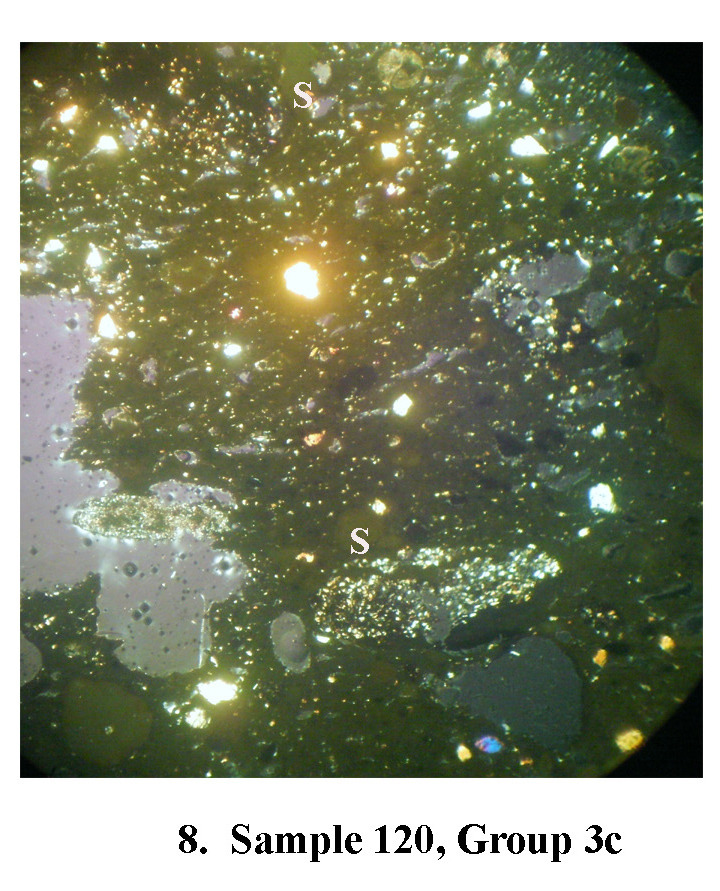
The fabric is characterized by a matrix dark to opaque in crossed polarized light and dark brown in regular polarized light. Particles are usually double-spaced and voids are 10–20%. This is probably a non-calcareous clay. the coarse:fine:voids20μm ratio (c:f:v) is 30–45:30–60:10–25. Several examples were probably fired in a temperatures 900 degrees or higher.
Non-plastics include mainly limestone, travertine and calcareous concentrations, together about 20% of slide area (chalk, limestone, travertine; usually up to 0.5 mm fragments), opaque minerals, quartz (5–20%, silty or bimodal, see below), shale (up to 5%, usually rounded up to 0.8 mm, occasionally up to 1.8 mm) and pellets. In several examples rounded oolitic limestone appears (as Samples Rehov 102 and 141; see e.g., Buzaglo and Goren 2006:387). Also, in smaller quantities there are chert fragments, basalt, feldspar, shell, micro-fossils and micas. The shale fragments are sometimes in moderate quantities (less than 1% of slide) but are quite dominant in this group. The quartz component is lower in several of the examples mostly angular silty with few sand sized up to 0.6 mm. In Group 3b there is more quartz (10–20%) with a poorly sorted/bimodal texture, with silty angular and sand sized angular to rounded particles.