
Lebanon/Northern Coast
Middle Bronze Age I
—
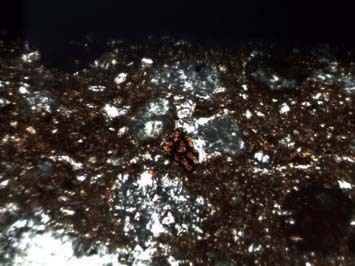
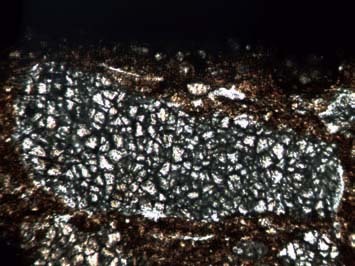
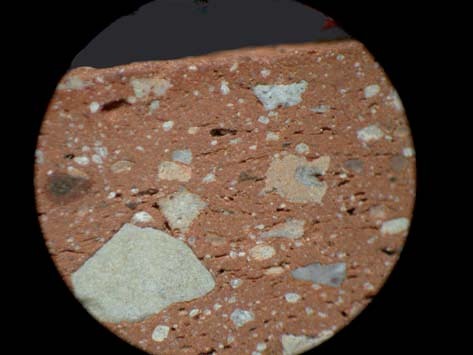
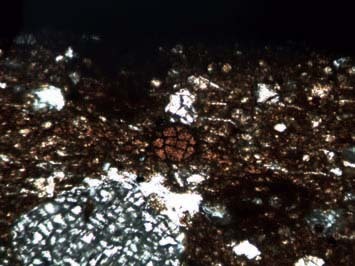
Fine textured ferruginous matrix, with an aplastic fraction of roughly 18–20% of the total sample and voids accounting for an additional 5–7%. The aplastic inclusions are usually rounded to subrounded/ The sand fraction of the samples is composed of large rounded grains of quartz and other siliceous material (probably chert) up to 1 mm in size with a mode of 0.5 mm (~7–8%). Rounded grains of iron-rich micritic limestone (up to 1 mm with a mode of 0.5 mm occur commonly (~3%) and react with HCL indicating a composition that includes high level of calcite. Oxidized red fragments of rock, almost weathered into clay, occur rarely and usually approach 1 mm in size; these are probably weathered fragments of basalt, but because of the high degree of weathering it is difficult to be certain. The fine sand and silt fraction contains rounded opaque (sometimes deep reddish brown) bodies that are probably hematite or magnetite (~1–2%). Rounded grains of iddingsite appearing orange or deep red in PPL occur (~1–2). An original olivine core is almost never present and the olivine is usually entirely altered into iddingsite. Only a few crystals of pure calcite were noted.
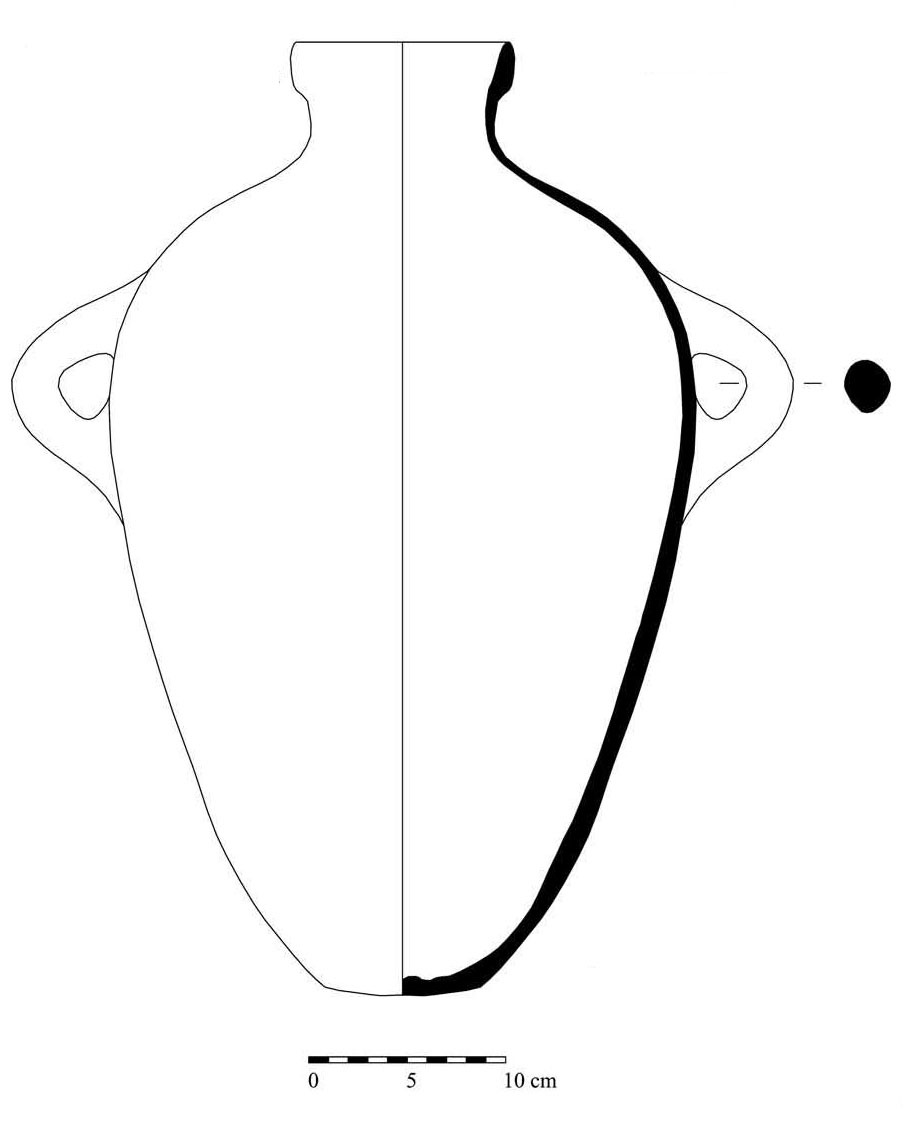
A provenience analysis will not be attempted, given the preliminary nature of this work. Many areas exist in the Levant that contain both igneous and sedimentary outcrops. The closest major igneous outcrops to Tell Fadous-Kfarabida can be found in the area north of Tripoli. The petrofabric of all three samples from the Middle Bronze Age tomb share some similarities with clays used for the Amarna letters defined by Yuval Goren et al., which have their origins in and around the Akkar plain, parts of the Orontes Valley, and the modern Syrian Coast. Further analysis is needed to pinpoint a more specific source area. However, it is clear given the characteristics of the petrofabrics from which this sample is composed, that it could not have been made of potting clays found in close proximity (i.e., a days walk) to Tell Fadous-Kfarabida.
