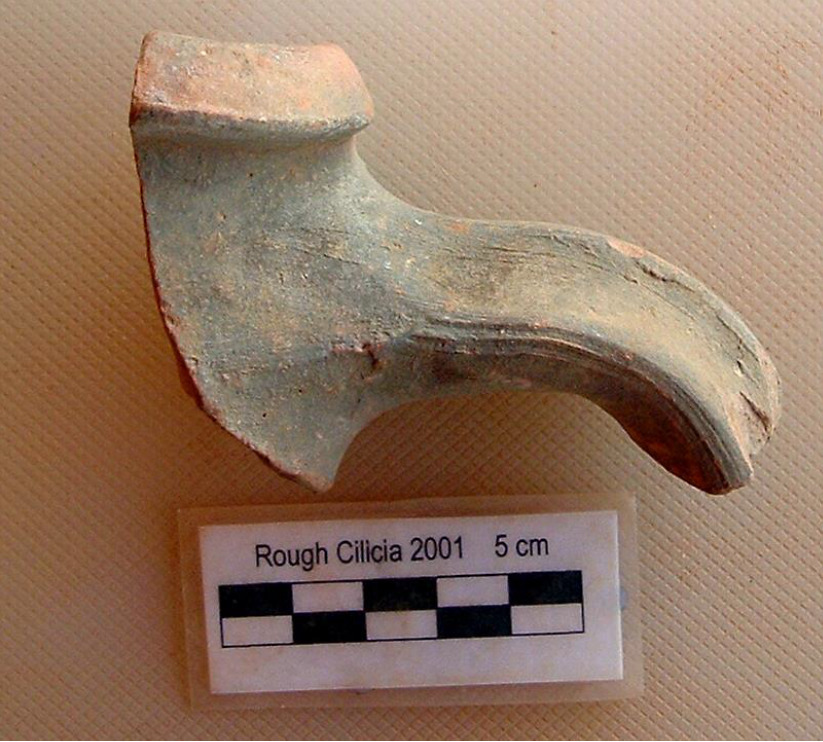
Delice Kiln site
8th - 10th c. CE
Early Byzantine, Early Islamic
Transport amphora
Background: The site was first identified by the Rough Cilicia Archaeological Survey Project in 1997, and a latter reassessment of overfired pottery and fired clay fragments by one of the surveyors determined a ceramic kiln likely existed there in the Late Roman and Byzantine periods.
Location: Behind a line of dunes, beyond which is the mouth of the Delice River, "several hundred meters (m) south of the site" (Rauh et al. 2023).
Number of kilns: Unknown.
Period of activity: It seems that the production centre was already active during the Roman times (Agora M239, 1st to 4th centuries), and activities were later resumed in the Early - Mid-Byzantine periods (8th to 10th centuries?), even though the ceramic assemblage identified generally dates to the 4th-7th c. (LRD-E).
Description of the facilities: No kiln structure has been located, but a clay pit with “large lumps of fired clay” and overfired pottery was found at the southern end of the ruined structure (Rauh et al. 2023:20).
Typology: LRA1 survival (which the excavators assert should be dated to the 8th-10th c., though this chronology seems late to the present contributors).
Local fabric: Consistent, fine, reddish brown fabric (2.5 YR 6/4 to 6/6, light red) with numerous medium red speck and small white lime speck inclusions. The fabric is very hard and often appears overfired on the surface (2.5 YR 5/1) (Rauh et al. 2023)