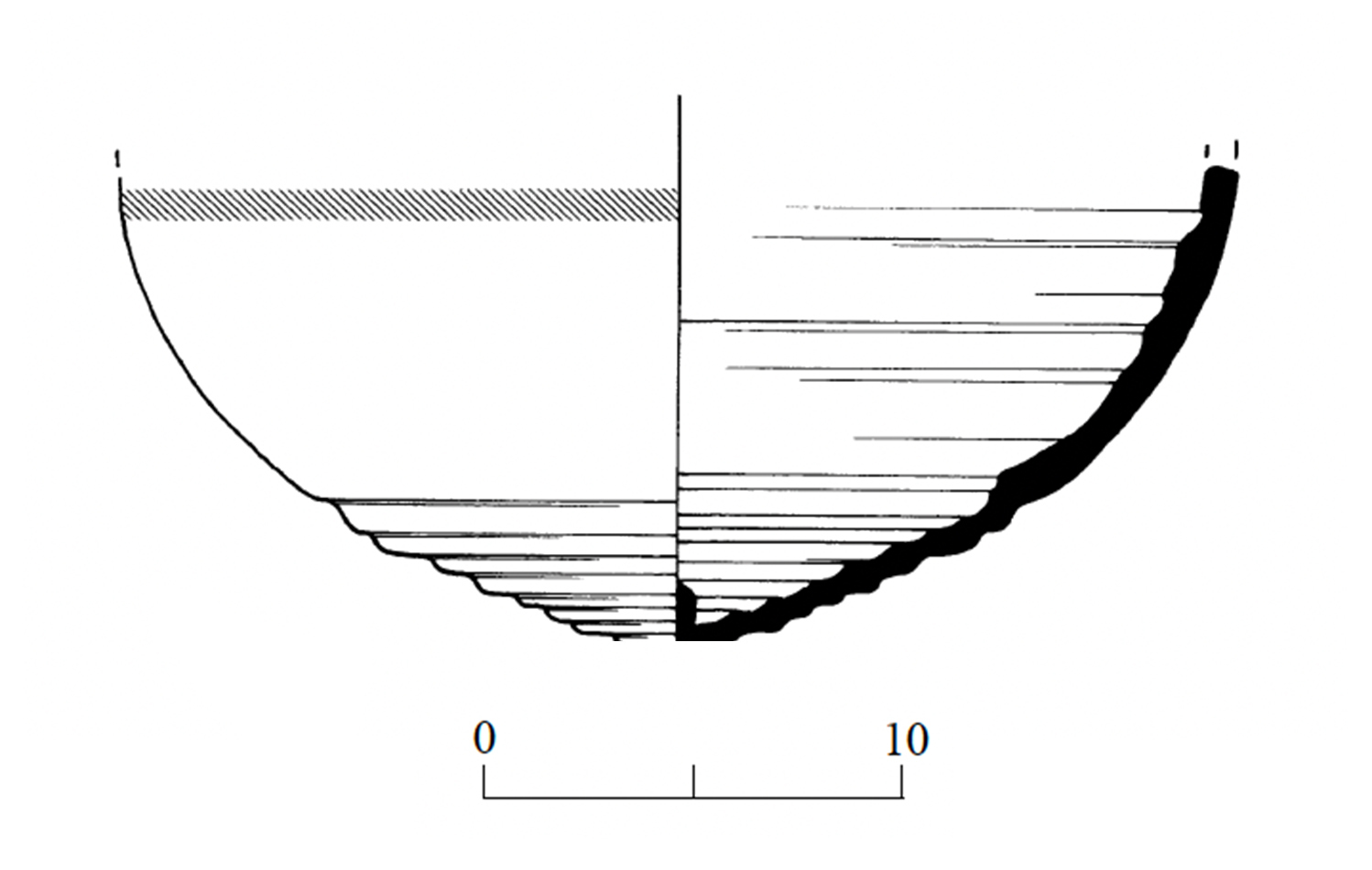
Ashkelon Third Mile Estate Area F late Roman Gaza jar kilns
3rd c. CE
Late Roman
Jar, bag-shaped
Five pottery kilns were discovered in Area F1 over an area of c. 300 sq m. Only the lower part of the kilns’ firing (combustion) boxes survived. Two kilns were fully excavated (L502, L507) and one was partially unearthed (L504); two kilns were left unexcavated (L505, L506). The close proximity of Kilns 505 and 507, only c. 5 m apart, may suggest that they belonged to a double kiln structure.
The kilns were round brick structures of the updraft type, measuring c. 3 m in diameter. Traces of arch springs constructed of bricks were found in Kiln 504, suggesting that the kilns had arches that supported the floors of the firing chambers. The remains of Kilns 502 and 507 contained a 1 m high collapse of bricks mixed with jar fragments and wasters, covering a layer of ash at the bottom of the firing boxes. This suggests that much of the kiln structure had collapsed inward in antiquity. Two types of bricks could be discerned: large and thin (0.4 × 0.8 m, 5 cm thick), which were apparently used in the construction of the firing chamber floor, on which the pottery vessels were stacked and fired; and small and thick (0.4 × 0.5 m, 0.1 m thick), which collapsed from the supporting arches.
The kilns contained a large amount of jar fragments, all of one type—an early subtype of the Gaza wine jar (Majcherek’s Form 1), dated to the first–third centuries CE (Majcherek 1995: Pl. 3:1).

Third Mile Estate, Area F, Kiln 504, looking northwest (Israel and Erickson-Gini 2013, fig. 5)